Distributed Systems
Designing Scalable Microservices in Node.js
A practical guide to service boundaries, contracts, and observability — designing Node.js microservices for a multi-vendor commerce platform.
4 min readNov 2025
Open to senior full-stack and backend roles
Building scalable systems, cloud-native applications, and high-performance digital products.
600K
Variants Priced
catalogue price sync I own
4.8x
Faster Price Sync
2.6 hours down to 33 minutes
99.5%
Cache Hit Rate
two-tier master-data cache
5
Tenant Platforms
Kisna · Iraah · Sadashree +2
01 · projects
Production systems shipped for Kisna, Iraah, PC Jewellers and Sadashree — select a build to inspect the problem, the architecture, the trade-off, and the shipped UI.
~/builds/price-sync-cache
product: Kisna Diamonds · Iraah — catalogue export service
role: Owner — profiling, cache design, benchmark write-up, rollout to two tenants
Problem
Recalculating prices across a 600,000-variant jewellery catalogue took about 2.6 hours, so it consumed most of a maintenance night and could not be re-run when rates moved.
Solution
Built a two-tier master-data cache — in-process on top of Redis — with concurrent misses collapsed into one query, negative results cached so missing records stop being re-queried forever, ObjectId-safe encoding, and compression above 1KB. It opens only while a run is in progress, so imports and single-variant paths always read fresh data.
Architecture
Sync run → cache warm-up → per-variant price calculation reading product, option set, price master, meta attributes and categories through the two-tier cache → batched variant writes replacing per-document updates; batch size and concurrency are environment-tunable, defaulted to match production exactly.
Key decision
Measure before touching anything. The assumption in the room was 'it is slow because the catalogue is big'. A query census showed 14,158 lookups over 1,000 variants resolving to 143 distinct documents — the job was re-reading the same master data tens of thousands of times, and no amount of extra hardware would have fixed that.
Shipped UI
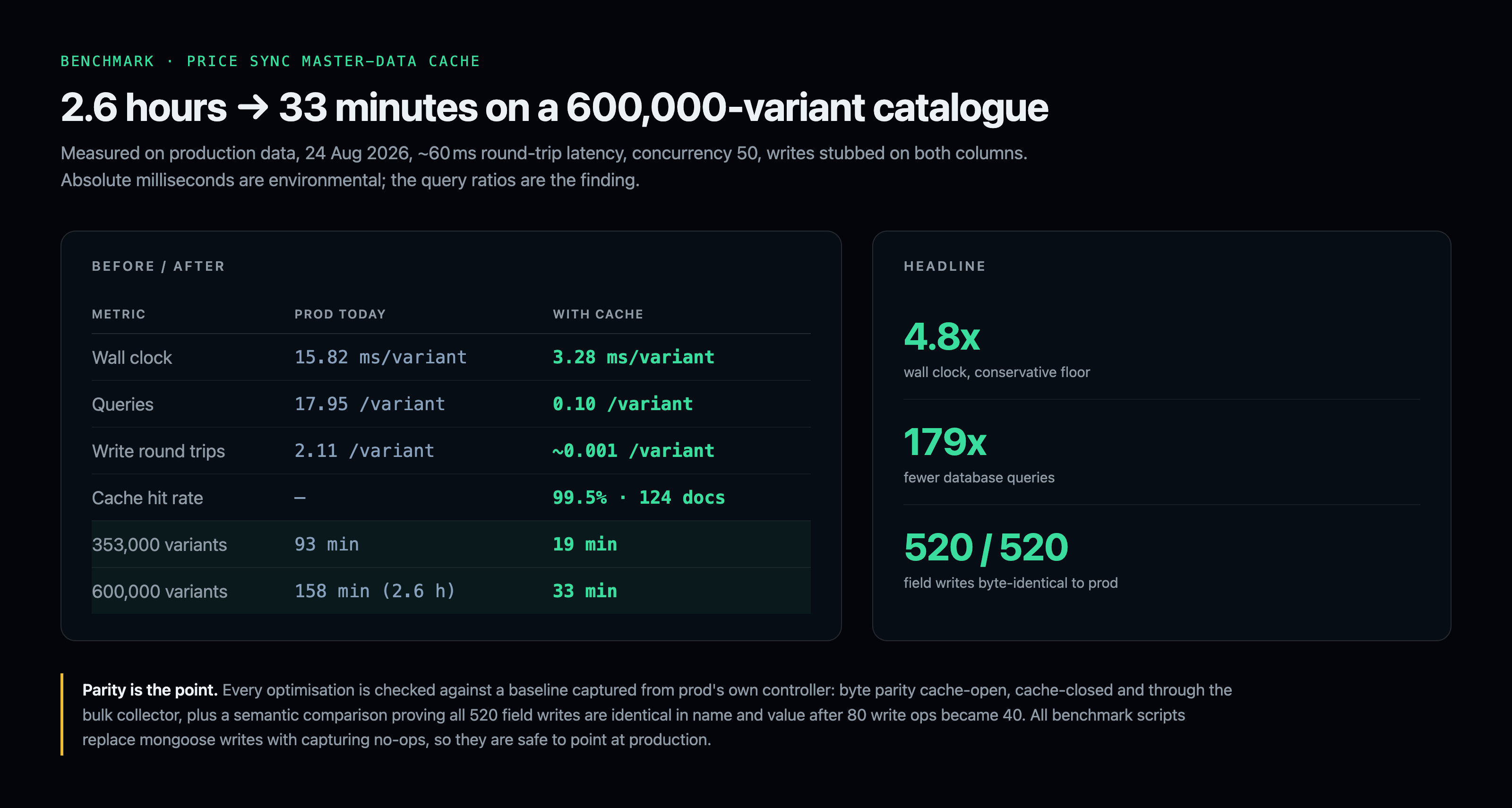
Benchmark: before/after on production data, with the parity checks that prove the output did not change
03 · experience
Commit history of a career — from research internships to owning production commerce systems.
Jul 2023 — Present
HEAD → mainBytive Technologies — Kisna Diamonds, PC Jewellers, Iraah, Sadashree
2022
Daulat Ram College, University of Delhi
2021
Cluster Innovation Centre, University of Delhi
05 · blog
Writing up the systems I build — published on Medium. Queues, caches, auth, and the failure modes between them.
A practical guide to service boundaries, contracts, and observability — designing Node.js microservices for a multi-vendor commerce platform.
EC2, Lambda, S3 and beyond — the AWS services that carry real production workloads, and when to reach for each.
Replication, sharding, caching, and the trade-offs between them — a guide to scaling databases before they become the bottleneck.
Step-by-step HTTPS for EC2-hosted sites — free certificates with Certbot, auto-renewed by cron so they never expire in production.
Work and personal GitHub on one laptop without credential chaos — per-account SSH keys and config, done professionally.
Two-part series on production auth in Node.js — JWT access and refresh tokens, Joi validation, and security middleware in Express.
06 · contact
Hiring for a senior full-stack or backend role? Building something that needs to scale? Let's talk.
$ ssh vivek@available
Open to senior full-stack and backend roles. Fastest response over email — typically within 24 hours.
India · Remote-friendly
02 · architecture
Interactive diagrams of systems I've designed and run in production. Drag to pan, scroll the canvas with the controls.
diagram://ecommerce
Multi-vendor storefront: CDN-fronted Next.js, an API gateway fanning out to domain services, Redis hot cache, and queue-buffered order fulfillment.
pinch to zoom · drag to pan
04 · skills
Years and production context, not self-graded percentages — where each tool has actually shipped.
skill.radar()
Skill radar: Frontend 90 out of 100, Backend 92 out of 100, Cloud / AWS 82 out of 100, Databases 86 out of 100, System Design 84 out of 100, DevOps 80 out of 100.
production apps, App Router era
SSR/ISR storefronts, dashboards
strict mode, end to end
services handling 1.2M+ events/day
API gateways, auth, rate limiting
multi-tenant schemas, change streams
streams, caching, sessions — on-call for it
SQS · EC2 · S3 · Lambda in production
every service containerized
zero-downtime rollouts, 6-node fleet
service boundaries, contracts
idempotency, at-least-once delivery
DLQs, replay, backpressure